
Conservation Digitisation
Being able to track and monitor wildlife and your conservation personnel effectively is essential for successful endangered species protection, poaching prevention, and the preservation of natural habitats.
Our tracking solutions provide accurate, real-time location data for tagged animals, rangers, vehicles, and other critical resources, helping conservation teams work more efficiently and respond to threats quickly.

Improve field visibility:
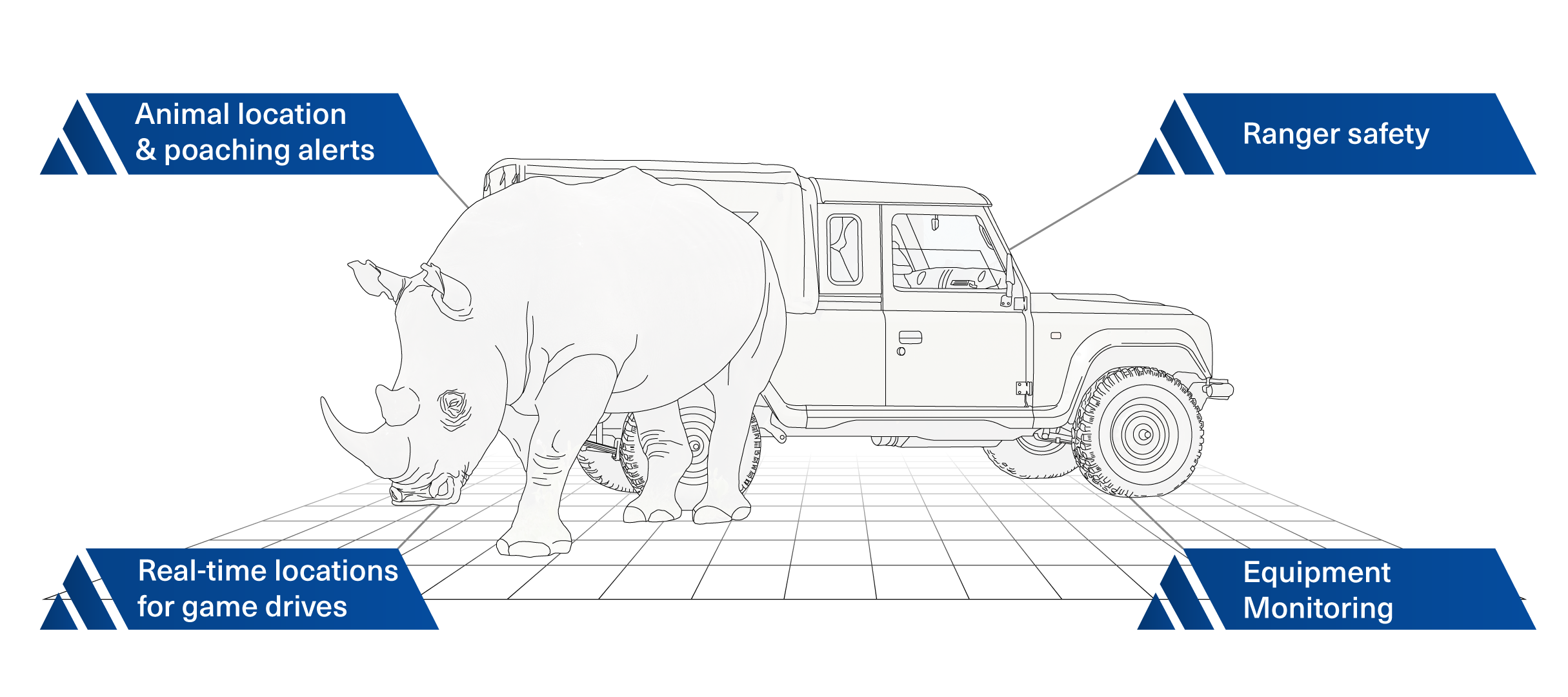
Track rangers, vehicles and equipment in real-time to ensure safety, prevent theft and improve response times in an emergency.
Improve animal monitoring:
Protect wildlife against poaching and habitat threats with automated tracking technology that provides precise geolocation for wildlife.

Increase equipment reliability:
Reduce the risk of signal loss with tracking devices with extended battery life and better accuracy to ensure continuous monitoring.
Improve ranger safety:
Arm your rangers and volunteers with tracking devices with built-in panic buttons, that alert control rooms to imminent danger, ensuring a swift response.
Get smarter vehicle control:
Keep track of your fleet, how it’s running and how much fuel the vehicles have to prevent delays and make the best use of your resources.
Conservationists are challenged with protecting animal species from the loss and fragmentation of their natural habitat, wire snares planted by bush-meat hunters, poaching and poisoning of animals, as well as people and disease-carrying domestic animals who come into contact with wildlife outside of protected areas.
Many scarce resources are required to deal with the above-mentioned threats including, but not limited to, rangers, ranger vehicles, k9 units, camera traps etc. The problem is that most conservationists lack the manpower to deal with the vast area that needs to be covered. Animals are, in most cases, still tracked manually and when tracking devices are deployed the equipment lacks the accuracy and battery life needed to be effective. There is no consistent visibility over personnel and equipment deployed in the field, opening up rangers and volunteers to unnoticed attacks from poachers and equipment is left vulnerable to theft or unmonitored breakage.
How It Works

Our devices allow rangers to get an approximate location of wild animals. By highly increasing the tracker's battery life, our trackers can provide real-time geolocation and have a lifespan that lasts for years.
The risk of having rangers and volunteers in the field is reduced by tagging them with state-of-the-art tracking devices, with a panic button built-in so the control room can be easily notified should the mobile personnel be in any danger.
Vehicle assets can be monitored, giving you important information such as location, whether the engine is on/off and its fuel level.
Benefits
Features
FAQ
How does the solution work?
Our tracking devices use a range of geolocation technologies such as GPS, Low-power GPS, Wi-Fi Sniffer, BLE and LoRaWAN TDoA. The gateway sends this location data to the cloud via Ethernet/WiFi or GSM.
What is the average battery life of your tracking devices?
The answer to this is that it varies. For instance, a personnel tracker can last up to 10 months sending a location once every hour. This device is easily recharged with a micro USB cable. Our industrial asset trackers can last up to 4 years sending a location once every hour. It is important that you choose a device based on your specific needs.
What is the average range of your gateways?
Our gateways use line-of-site and on average can collect data at ranges of 7-15km. We have however done tests with ranges of 200+km. We also help you with radio propagation studies before installation to ensure the desired area is properly covered.
Let's grab a coffee

Company
Contact
Katherine St & Centex Cl,
Strathavon, Johannesburg
Gauteng
sales@iotdc.co.za
+27(0)11 568 7151
@2025 IoTdc. All rights reserved.
Terms & Conditions